The Seattle Real Estate Market Is Complicated. The News Is Making It Worse.
My colleagues are texting about bidding wars. The Seattle Times says buyers aren't showing up. Here's what's actually going on.
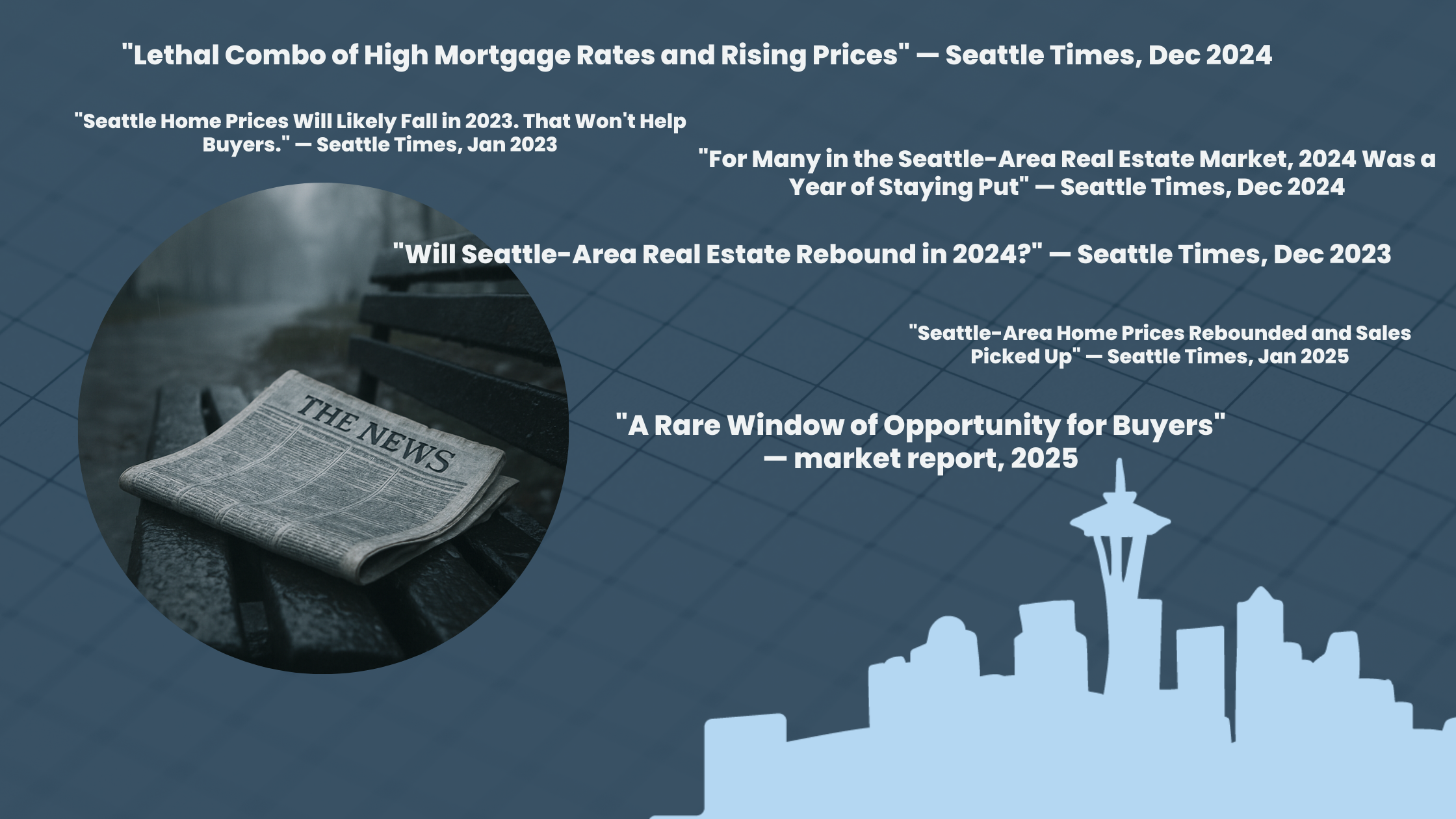
Real news headlines about the Seattle Real Estate market. Why real estate news is old news, and what to do about it.
The Seattle market you're reading about isn't the same market you're buying in.
If you've spent any time in business or tech, this might sound familiar. You know the feeling of sitting in a meeting staring at metrics on a slide deck and having absolutely no idea if a product is about to become the company's new poster child or get quietly cancelled. The success metrics are green but they're probably watermelons (green on the outside, red on the inside). Revenue is up but daily active usage is down. Usage is down but nobody's churning, so maybe that's fine? All the leaders have a point of view about what's happening in the business, but they're all talking past each other trying to be the loudest voice in the room.
That's a lot like the Seattle real estate market right now, if you're getting your information from the news.
One week, the headline is: "Home prices cooling as buyers pull back." The next week: "Bidding wars return as inventory tightens." Last month: "Rising rates slam affordability." This month: "Buyers flood back as rates stabilize." All of these can be true. None of them are particularly useful or even accurate, within a dynamic market like Seattle. And those are just the made-up headlines to illustrate my point.
The real ones are even better. Early 2025, the Seattle Times warned of a "lethal combo of high mortgage rates and rising prices." A few months later, a market report declared it "a rare window of opportunity for buyers." Around the same time, another outlet described the Seattle market as one where "intensity shows up only where it's earned," which sounds wise but tells you absolutely nothing about whether to make an offer on Thursday.
Just this week, a Seattle Times article reads: "Sellers' enthusiasm is not being matched by buyers'" and "Seattle is still in buyers' market territory," while my colleagues and I are actively texting about homes that received multiple offers this week, some escalating as high as 25% over asking. Same market. Same city. Completely different stories. This is the noise problem.
In product, we talked a lot about the difference between signal and noise. Noise is high-volume, emotionally activating, and usually not useful for decision-making. Signal is specific, timely, and actionable. The problem is that noise often looks like signal. It comes dressed in charts, expert quotes, and authoritative tones.
Real estate media has the same problem. Headlines are almost always lagging indicators. By the nature of the business, they're reporting on data that's 30, 60, sometimes 90 days old. By the time a trend makes it into a Forbes article or a CNBC segment, the market has long since moved on.
Here's what I mean. "Seattle home prices up 4% year-over-year" tells you almost nothing if you're trying to decide whether to buy a 3-bedroom in Ballard under $900K this week, or sell a condo in Belltown before summer. The market for a $750K townhouse in Ballard is not the market for a $1.4M single-family on Phinney Ridge. These are different games being played on different boards, and the evening news is giving you a weather report for the wrong city.
Here's what might actually be useful to know:
What has sold in that specific neighborhood in the last 2–3 weeks?
How many days are properties like yours, in location, condition, and style, taking to go pending?
Are offers going over asking, under asking, or at asking, and by how much?
What's the absorption rate for that price band and property type right now?
This information exists, and it paints a completely different picture than whatever headline ran this morning. But you need to know where to find it and how to interpret it, and that's one of the many reasons to work with an experienced, local, well-connected real estate agent in your market.
A good agent isn't just a transaction facilitator. They're a real-time data feed for a market that isn't well-covered anywhere else. They know what's happening on the ground: what types of properties are generating interest, what's sitting, where sellers are getting flexible and where they're not, what offer terms are winning right now, and what listing preparation has the highest return on investment for your location and property type. That's signal. Everything else is mostly noise.
The reason this matters right now is that fear is doing a lot of work in this market. Rates are still high compared to the 2020–2021 era that many buyers use as their mental benchmark, and that creates hesitation. Hesitation creates risk. Specifically, the risk of missing something genuinely good while waiting for someone to tell you it's safe. I see a trend of buyers waiting for an all-clear signal to start looking in earnest, then scrambling when the home they'd been dreaming about sells quickly to someone who was paying attention to the right data and was already emotionally and financially prepared to make the offer.
And this creates a vicious cycle: while those buyers are waiting to make a move, they aren't selling their current homes. More scary headlines. Less inventory. Repeat.
Here's the irony: real estate is psychological, and buyers tend to buy in packs. When they see other buyers out there buying, they want in. Waiting until more people are in the market doesn't mean you're being smart. It means you'll be competing harder and paying more. The "safe" moment to buy is the more expensive one.
So don't wait for the news to give you the all-clear. Don't wait for your friends to start buying again. If you've been letting headlines make your real estate decisions for you, consider this your signal.
Real estate news runs on delays. I can help you make good decisions today.
What are you seeing out there? Does the market feel like the headlines, or something completely different on the ground? Drop a comment or reach out directly. I'd love to compare notes.